
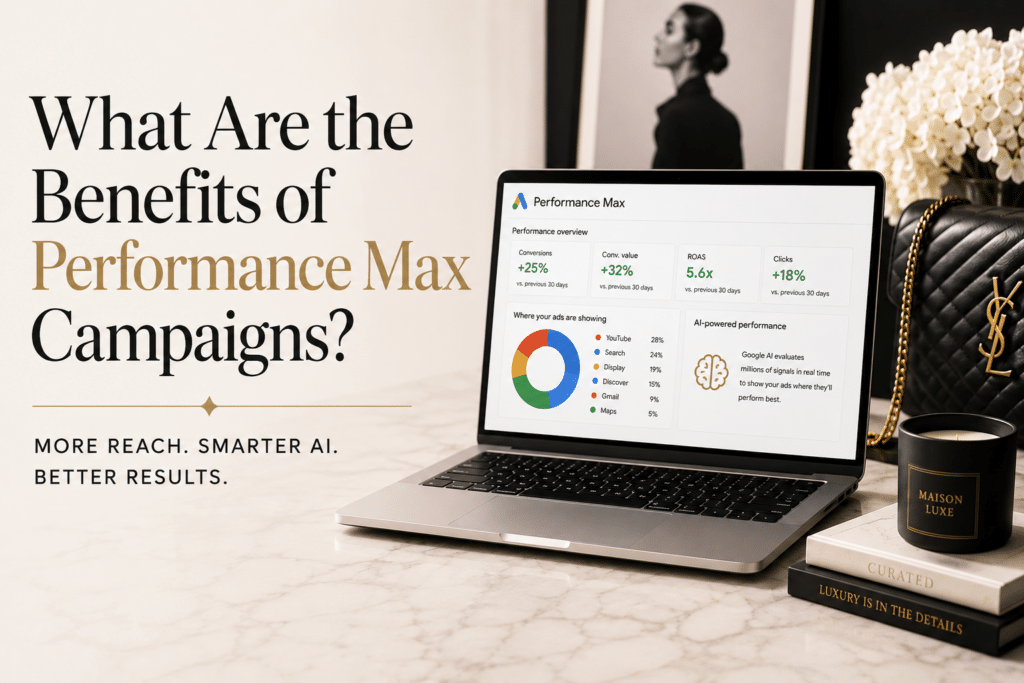
Performance Max, or “PMax”, is one of Google’s most automated campaign types. It promises wide reach, smart bidding, and ad space you couldn’t manage manually. It’s appealing, but for luxury e-commerce brands there’s a real tension underneath: how much creative control are you willing to hand over to get those efficiency gains?
What Are the Benefits of Performance Max Campaigns?
Performance Max’s main benefit is that it manages your ads across Shopping, Search, Display, YouTube, Discover, Gmail and Maps from a single campaign, using Google’s AI to decide in real time where your budget will work hardest. Done well, this combination of wider reach and smart bidding can outperform manual, channel-by-channel management, especially when it comes to uncovering new customers ready to buy.
Does Performance Max Hurt Brand Control?
Performance Max can reduce brand control because so much of the campaign, from creative selection to placement, is automated rather than manually chosen. The concern isn’t whether PMax works, it’s how it works. Brand tone and visual identity can get diluted when Google’s AI generates creative on your behalf, and there’s a risk of ads appearing alongside content that doesn’t match your positioning. For luxury brands, that’s not a small trade-off.
How Can You Keep Brand Control in Performance Max?
You can keep brand control in Performance Max by supplying strong, brand-aligned assets and regularly auditing what Google’s AI generates. Strong video and image assets reduce how much Google’s AI needs to fill gaps itself. Writing headlines and descriptions with real intention matters more, since that copy can be reused by Google’s AI in other formats. You can also guide things by telling Google which audiences to focus on or which placements to avoid. And checking what’s actually been generated, including any new AI-created assets, means nothing goes live without a brand check.
Should You Fully Automate Performance Max Campaigns?
You shouldn’t fully automate Performance Max without oversight. It performs best treated as a capable assistant that still needs direction, not a replacement for brand judgement. The brands that get the most out of PMax are the ones still actively shaping the inputs, even while letting Google handle the heavy lifting on delivery.
Automation and brand control aren’t opposites. With the right oversight, they coexist comfortably, and for luxury e-commerce brands, that oversight protects the very thing that makes the brand valuable in the first place.
If you’d like a second pair of eyes on how your Performance Max campaigns are balancing automation with brand control, get in touch. We’d be happy to take a look.