For fashion brands, paid media isn’t about choosing one platform. It’s about knowing when and why each channel works and Google Ads and Meta Ads play very different roles in the customer journey, and understanding that difference is key to profitable growth.
Below is a breakdown to help you decide where your budget should go and how to use both platforms properly.
The Core Difference: Intent vs Discovery
Google Ads = Intent
Customers are actively searching
Demand already exists
Best for capturing high-quality traffic
Meta Ads = Discovery
Customers aren’t searching yet
You create demand visually
Best for brand building and new customer acquisition
For most fashion brands, performance improves when these platforms work together, not in isolation.
When Google Ads Works Best for Fashion Brands
Google Ads performs best when there is already demand for your brand or products. It is particularly effective for protecting branded search if you have wholesale partners, capturing high-intent category searches such as specific dress types or occasions, and driving revenue through Shopping ads. It also plays a key role during sale periods, when customers are actively comparing options and looking to purchase quickly.
The strength of Google Ads lies in its predictability and ability to convert ready-to-buy customers, but scale is limited if demand does not already exist, and costs can be competitive in the fashion space.
Pros:
High purchase intent
More predictable ROAS
Strong performance during sale periods
Cons:
Limited scale without demand
Competitive CPCs in fashion
Less effective for unknown brands
Best for:
Established brands, strong PR moments, repeat customers, and product-led demand.
When Meta Ads Works Best for Fashion Brands
Meta Ads are strongest when the goal is to build demand and reach new customers. It allows fashion brands to showcase collections visually, tell a brand story, and introduce products to audiences who may not yet be searching for them. Meta is especially effective for new launches, seasonal collections, and ongoing prospecting, as well as for retargeting website visitors and email subscribers.
Performance on Meta is heavily driven by creative and testing, but when done well, it is one of the most scalable channels for fashion brands looking to grow beyond existing demand.
Best use cases:
Launching new collections
Introducing your brand to new customers
Visual storytelling (editorial, UGC, video)
Retargeting site visitors and email subscribers
Pros:
Strong creative-led performance
Scales new customer acquisition
Excellent for building brand affinity
Cons:
Results depend heavily on creative
Requires testing and iteration
Attribution can feel less direct
Best for:
Growing brands, new customer acquisition, seasonal launches, and visual products.
Budget Split: What We Typically Recommend
For smaller or emerging brands, a heavier investment in Meta Ads usually makes sense, as it helps create demand and build awareness, with Google Ads supporting branded and high-intent searches. More established or scaling brands often benefit from a more balanced split, using Meta to fuel discovery and Google to efficiently convert demand.
During sale periods or high-demand moments, increasing spend on Google Ads can help capture shoppers who are actively searching and ready to buy.
Smaller / Emerging Brands
Meta Ads: 60–70%
Google Ads: 30–40%
Focus on demand creation first, then capture it.
Established / Scaling Brands
Meta Ads: 50–60%
Google Ads: 40–50%
Use Meta to drive discovery and Google to convert intent.
Sale or High-Demand Periods
Temporarily increase Google Ads to capture active shoppers searching now.
The Biggest Mistake Fashion Brands Make
The most common mistake is treating Google Ads and Meta Ads as competing channels. In reality, they work best together. Meta creates demand and interest, while Google captures that demand when customers move closer to purchase.
Brands that rely only on Google often hit a growth ceiling.
Brands that rely only on Meta often struggle with consistency.
The strongest results come when:
Meta drives awareness and traffic
Google converts high-intent searches
Email (via Klaviyo) supports both with retention and remarketing
There’s no single “better” platform for fashion brands only a better strategy.
If you’re deciding where to invest:
Use Meta Ads to grow your audience and brand
Use Google Ads to convert demand efficiently
Let Shopify and Klaviyo data guide budget shifts month to month
When aligned properly, these channels compound and that’s where profitable growth happens.
If you’re unsure where your paid media budget should sit for your brand, we can review your goals and current performance map out a clearer strategy. Get in touch to book a discovery call.
Key Features For Fashion Advertisers
-
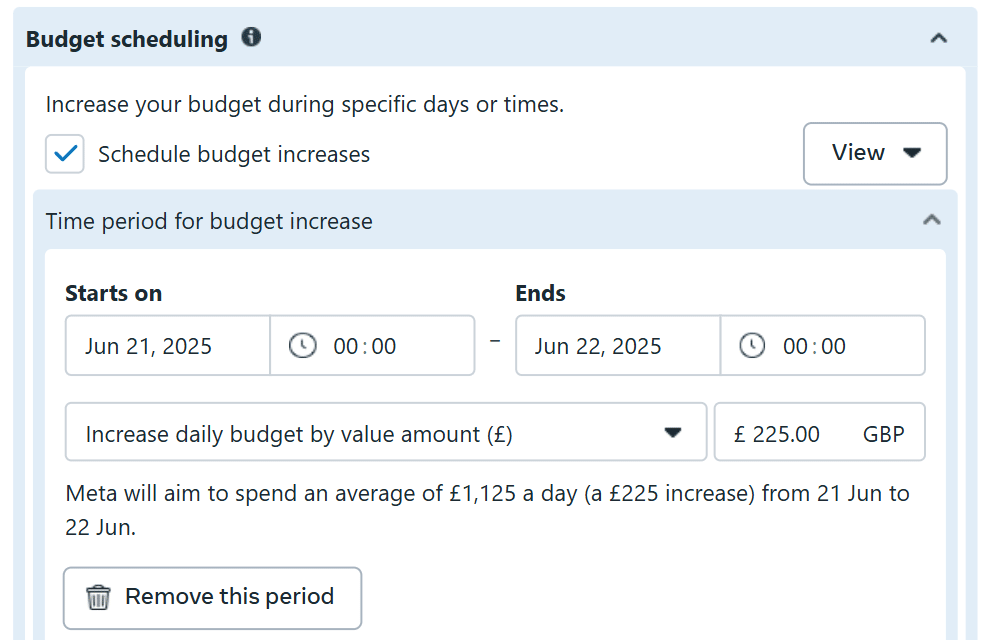
Daily Budget Only – Available for campaigns using a daily budget.
-
Up to 50 High-Demand Periods – Perfect for planning seasonal campaigns months in advance.
-
Budget Increase Cap – Can’t exceed 8x your daily budget in high-demand periods.
-
Minimum 3-Hour Blocks – Ensures meaningful coverage during peaks.
Maximise performance during peak shopping times by reaching more shoppers when they’re most active and ready to purchase. Gain greater control over your campaign strategy by pre-planning spend around key dates and events, and use your ad budget more efficiently by avoiding overspending in quieter periods while focusing investment where it delivers the highest conversions. With automated scheduling, you can boost results without constant manual adjustments — a major advantage for global campaigns running across multiple time zones.
How Fashion Brands Can Use Budget Scheduling Effectively
-
Map your seasonal calendar – Include sales events, collection launches, influencer posts, and PR moments.
-
Analyse past performance data – Identify timeframes when your audience is most active.
-
Plan high-demand periods in advance – Schedule boosts around these dates to capture peak intent.
-
Test and refine – Adjust based on real-time performance for continuous improvement.
Why This Matters for Fashion Brands
The fashion industry thrives on urgency and trends — from “must-have” pieces to viral looks. By using Meta’s Budget Scheduling, you can ensure your ads appear when your audience is most engaged, helping you capitalise on demand without inflating your monthly budget unnecessarily.
By planning budget increases strategically, you’re not just spending more — you’re spending smarter.